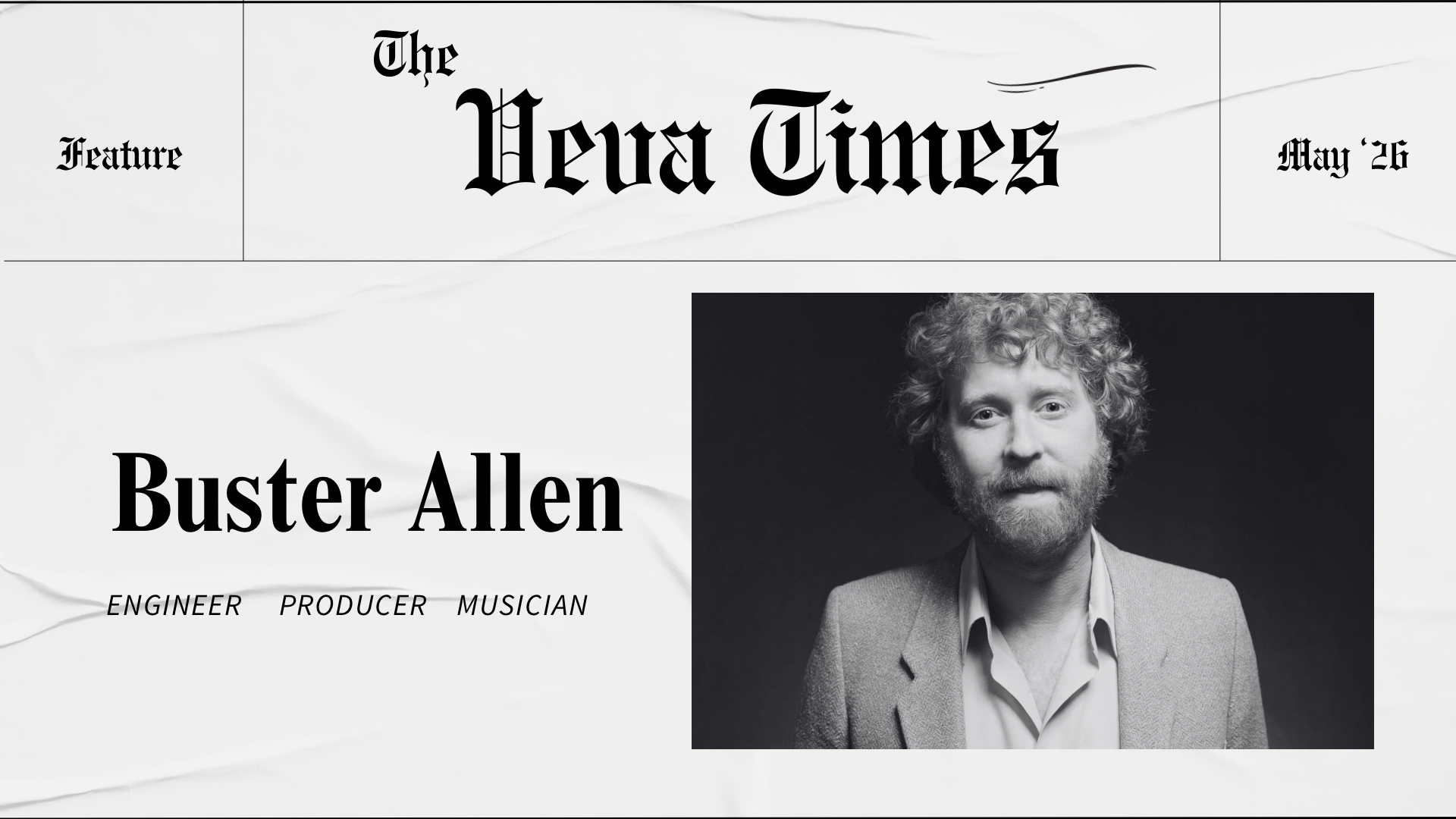
Buster Allen
Can you take us back to the beginning? How did you first get into audio engineering, and what made you realize this could become your career?
Playing trumpet and guitar in our high school symphonic and jazz programs ultimately led me to discovering the recording process. My parents bought me Sony Acid, a pretty basic recording software that worked on PC. My grandparents bought me a Shure sm57, cable and mic stand. I was set!! I plugged the mic straight into the sound card and would make demos with my friends. A friend and local musician named Devon Bott worked a lot on a Tascam 4 track cassette and he would play me demos as we would be playing in bands. For college, I started as a music major that would end up leading me to a band teacher. I quickly discovered that probably wasn't going to be the best path for me and I switched to audio production. Bill Porter, famous Nashville recording engineer, happened to be one of the teachers there and that really blew the door open for me. Bill recorded Elvis, The Everly Brothers, Chet Atkins, Roy Orbison and more. He was a big part of what is called "The Nashville Sound" from that period. I moved to Nashville in 2006 and met so many great people very quickly, and things just took off in a lot of directions.
When you’re working with an artist how do you balance the emotional/artistic side of the music with the technical side of engineering?
When I'm working with an artist the technical side is pretty minimal. That part should already be done and invisible prior to the tracking or overdub day. Songs have been picked, rough musical concepts have been discussed, and the players have been decided. The last thing you want to be doing is slowing any progress down by changing things around while the artist and players are waiting to do a take. You can quickly change a mic between takes if something just isn't working and that layer of invisibility is very important to keeping the balance of the session in order. I never want to stop the motion once the players have their way to magic.
A big part of your career has been your work with Garth Brooks. Could you tell us how that came to be and some of your highlights working in his camp?
In 2006, a knock on the door at Jack's Tracks Recording Studio and a general curiosity of their Quad Eight Coronado console led to an 18 year gig. Allen Reynolds owned the studio at the time. He produced Garth, Emmylou, Crystal Gayle, Kathy Mattea, and many others. Mark Miller was his longtime recording engineer. We became friends and I'd stop by for coffee or go get lunch. Mark called one day to see if I wanted to watch a big Garth Brooks session and just help out, so we went to Sound Emporium and I watched them record a big choir and strings all together. Mark asked if I could help him the next day over at the studio with big band and it just went from there. It was a paid training ground as time progressed. Allen retired, Mark and I co-engineered for a while, and then Mark moved over to producer and I did more engineering and mixing. Mark left and then it was Garth and I working from 2016-2023. We recorded about 10-14 albums, made a bunch of boxed sets, a really great vinyl boxed set, and then I was out overseeing live show recordings and TV specials. It always kept you on your toes and you were never really sure what would come up next. The musicians were top notch and working with Trisha Yearwood was always a treat. We spent the day with James Taylor for a session that was really a nice memory. Recording a few live shows like LSU stadium and Croke Park in Ireland were pretty special. Hearing something you mixed that got to radio was pretty amazing. I spent a lot of time working on "Triple Live" which was a follow up to one of Garth's best selling albums called "Double Live". No pressure there! I think I picked about 70-80% of the takes, we'd get them fixed up and mixed. I think it has sold about 7 million copies now! It was the opportunity of a lifetime.
In Nashville you are renowned for your knowledge of 3M tape machines, and in 2009 you founded Allen Sound. What drew you to 3M tape machines? What excites you about analog recording, and does it still have a place in today's studio setup?
The 3M just looked really great! Tape was mysterious in college. We didn't have a multitrack, but we had a great advanced electronics class that taught us about them. I would read on the Tape Op forum, Gearspace forum and Harmony Central forums all the time looking for equipment. When I moved to Nashville I started interning at Blevins Audio when I wasn't interning at Omni Sound. Randy Blevins, the owner, really took me under his wing with MCI console and Tape machine repair. Mainly at that time it was more advanced signal flow. Randy bought me my first 3M M79. It was a 1/4" 2trk that we picked up in Phoenix, Az on a big audio trip we took buying and dropping off audio equipment. A few years later he received an email about a bunch of 3M parts that had been left over from the factory and maybe 7-10 machines. I took out a loan that my parents cosigned on so I could even get the money. I think I have met more people in the audio business from being the 3M guy than anything else honestly. It was worldwide and I had so many great clients who turned into great friends. 3M is a pretty small club. Wonderful sounding machines that recorded some of the biggest records ever. Led Zeppelin, The Who, The last Beatles records, Boston, John Lennon, George Harrison and on and on.
Analog does sound very good but it's also tactile. You are very involved with the process and everyone has an elevated sense of what they are doing is important. You have to be able to play and record exceptionally well to really get the most out of analog. I think analog still has a lot of merit and it's a choice to work that way. The musicians in Nashville would make it so easy to make a great record on tape because they are so great. You'd probably just have to slow down a little bit as a pro tools workflow can be very fast and relentless. The key is to bring in the analog mindset into a modern recording. Make things intentional and commit to ideas and move on. It's amazing what you can accomplish with that mindset.
With so much music being made remotely, how has file sharing and digital collaboration changed your workflow?
File sharing and digital collaboration is just part of it now. The equipment and ability to record has become so accessible that most people can record an overdub and send it on to the engineer or producer. I think it depends on my role in the project and how it affects what I'm wanting. I really try to get people to come over and do an overdub together as time and time again the result is undeniably better.
Do you think better file management can actually lead to better music? Why or why not?
I think file management and the proper maintaining of the files will lead to the music projects being made more efficiently. While I was working for Garth Brooks I had a vast knowledge of his catalog, most of which I was not even around for. I learned the catalog inside and out through listening and general knowledge passed down through the people that came before me. Garth had invested in digitizing his masters with a VEVA Sound. We had a searchable database and binders of information organized by song, or album. It was all searchable one way or another. His investment in doing all of that work allowed us to quickly and efficiently create future boxed sets of new and old works and be confident in the masters selected. We remixed almost every album he recorded with no real issues or questions that I can remember.
How does quick, secure file sharing impact the creative flow of a project?
Mainly people want to know their work is safe and can be accessed quickly. People that aren't always the most technical need to easily be able to figure out what the newest version or file is for their project. Security on unreleased material is very important and security from AI is next.
Recently you’ve done a lot of live recording for artists on the road, what are the challenges working with live verses in the studio?
When you come into an environment like an arena, stadium or club there are so many factors to try and get a great live recording. Is the space reflective? Is it open air? What is the humidity like if it's outdoor? These are real and big factors of how the show is going to turn out. The ability to capture the sound of the room and the audience is what sets actual live recordings apart from PA recordings. Most bands or projects that I get called in to help on are great acts and you just need to do a good job of capturing their signals whether that is analog or digital in today's live systems. Balancing them against the audience and room sound is what makes a great live record. The fans that really bring it and sing their hearts out give you a million dollar sound if you can capture it. I saw it every night with Garth and most recently with My Chemical Romance. Their fans are incredible.
For people trying to break into engineering or production today, do you have any advice? What skills do you think matter most?
A few things come to mind that are not really engineering skills. They are just general life skills it takes to stay in the game and be around people. For starters, this is a service. We are providing a service to these artists and musicians. Do you want McDonalds or would you like a nice sit down restaurant? The choice is yours to deliver. Can you be in a room with people and be pleasant? Do you know your role and when to speak in the control room? Are you aware of the chain of command within the studio environment? The studio can be a collaborative environment but it's important to know if that includes you or not. Can you sense the unsaid feelings in a room of five musicians and an artist when things may not be going well and how do you encourage, diffuse or steer a group of people to a place of comfort? You'll learn that one. I studied martial arts for 10 years, age 7-17. I think that training prepared me to fuse into environments and read rooms early on. Combine that with a high level of studio work and I probably should have a masters in psychology by now!